

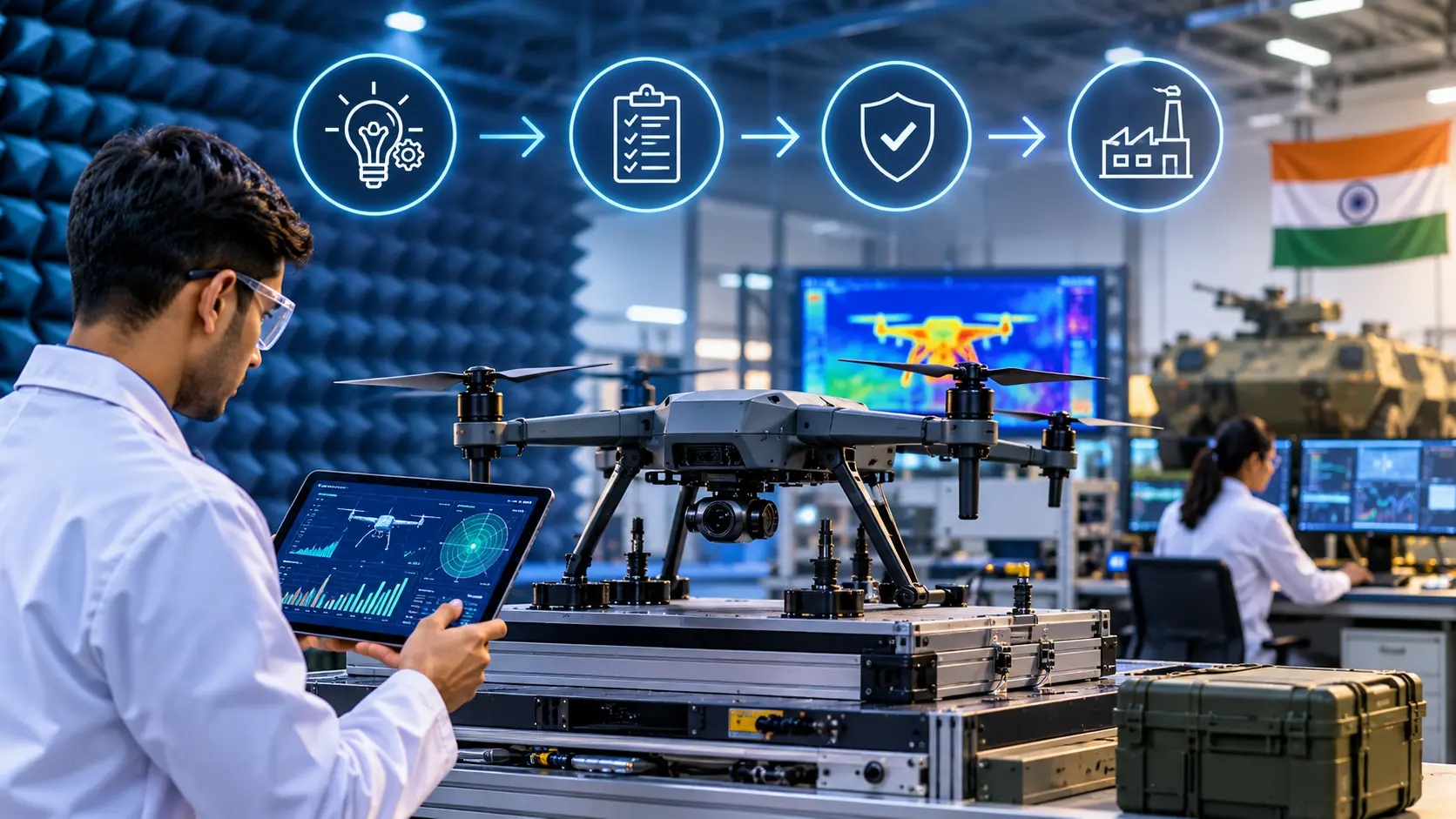
India's defence innovation ecosystem is witnessing growing participation from startups, MSMEs, research institutions and established manufacturers. New ideas are emerging across drones, robotics, artificial intelligence, advanced electronics, surveillance and communication systems.
However, developing a working prototype is only the first step. Defence technologies must demonstrate reliability, safety and consistent performance before they can be considered for operational deployment.
This makes testing and validation essential to the journey from innovation to production.
Innovation Is Only the Beginning
India's defence innovation ecosystem is witnessing growing participation from startups, MSMEs, research institutions and established manufacturers. New ideas are emerging across drones, robotics, artificial intelligence, advanced electronics, surveillance and communication systems.
However, developing a working prototype is only the first step. Defence technologies must demonstrate reliability, safety and consistent performance before they can be considered for operational deployment.
This makes testing and validation essential to the journey from innovation to production.
Why Testing Matters in Defence
Unlike many commercial products, defence systems must operate in demanding and unpredictable environments. Equipment may face extreme temperatures, vibration, dust, moisture, electromagnetic interference and challenging operational conditions.
Testing helps identify design limitations, assess system performance and improve reliability before deployment.
Depending on the technology, evaluation may involve environmental testing, electromagnetic compatibility assessments, software validation, field trials and integration testing.
A structured testing process reduces technical risks and builds confidence among potential users and procurement stakeholders.
Bridging the Gap for Startups and MSMEs
For emerging defence companies, accessing testing infrastructure, specialised expertise and suitable evaluation facilities can be challenging.
Collaboration with defence research organisations, testing laboratories, academic institutions and established industry partners can help bridge these gaps.
Startups can benefit from early technical feedback, while larger manufacturers can identify promising innovations for integration into existing platforms and supply chains.
Scaling Indigenous Technologies
Successful validation creates a stronger foundation for manufacturing. Companies must then focus on production consistency, component availability, quality assurance, documentation and lifecycle support.
Building these capabilities can help Indian defence innovators move beyond prototypes and develop solutions suitable for wider adoption.
Turning Innovation into Capability
The future of India's defence manufacturing ecosystem depends not only on developing new technologies but also on making them dependable, scalable and operationally relevant.
By strengthening testing infrastructure and encouraging collaboration between innovators, researchers and industry, India can accelerate the journey from indigenous ideas to deployable defence capabilities.
BDTS 2027 – Forging the Sovereign Battlespace brings together defence stakeholders, technology developers, startups, researchers and manufacturers to connect innovation with real-world defence requirements.