

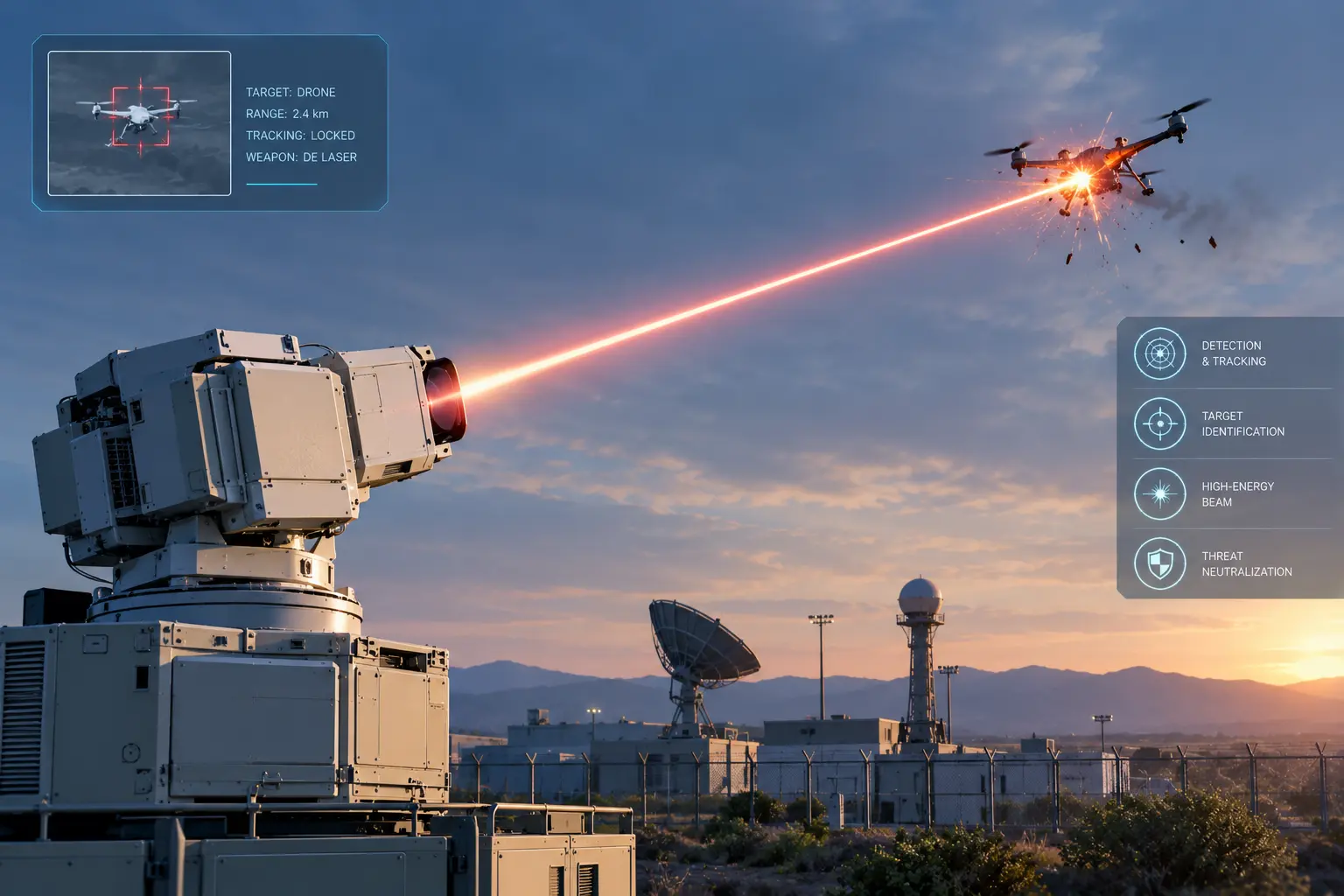
Directed Energy Weapons and the Future of Defence Technology
The evolution of defence technology is creating new approaches to detecting, tracking and responding to emerging security threats. Among these developments, directed energy weapons (DEWs) are attracting attention for their potential applications in air defence, counter-drone operations and the protection of critical infrastructure.
Unlike conventional weapons that rely on physical projectiles, directed energy systems use concentrated energy, such as high-energy laser beams or high-power radio-frequency energy, to achieve specific effects on a target. Their development represents an important area of research within the broader global defence technology landscape.
Understanding Directed Energy Technology
High-energy laser systems focus optical energy on a designated target, while high-power microwave systems use electromagnetic energy to affect electronic components under suitable conditions. These technologies have different applications and technical requirements.
Their potential advantages include rapid energy delivery and, in certain applications, reduced dependence on conventional ammunition. However, system performance depends on factors such as power generation, beam control, cooling, atmospheric conditions and target characteristics.
Engineering Challenges and Emerging Innovations
Developing operational directed energy systems requires advances across several engineering disciplines. High-performance optics, precision tracking, thermal management, power electronics and sophisticated sensors all contribute to system performance.
Integration is equally important. Directed energy platforms must operate alongside detection, surveillance and command systems to support timely assessment and coordinated responses. Extensive testing is necessary to establish reliability under varying environmental and operational conditions.
Opportunities for India's Defence Industry
India's growing defence technology ecosystem offers opportunities for startups, MSMEs, research institutions and established manufacturers to contribute specialised capabilities. Areas such as optical components, semiconductor devices, advanced materials, cooling systems, power electronics and precision control technologies can support indigenous development.
Collaboration between researchers and industry can help move promising technologies from laboratory research towards validated prototypes and scalable manufacturing. Building domestic expertise in these areas can also strengthen the wider defence supply chain.
BDTS 2027: Advancing Strategic Defence Innovation
Bharat Defence Tech Show (BDTS) 2027 provides a platform for engagement across India's defence technology ecosystem. Emerging technologies such as directed energy systems create opportunities for discussions around research, component development, industrial collaboration and indigenous manufacturing.
Conclusion
Directed energy weapons remain a technically demanding but significant area of defence research. Their future development will depend on reliable engineering, effective integration and sustained investment in advanced technologies. Strengthening India's indigenous capabilities can contribute to a more innovative and technologically resilient defence ecosystem.